
September 29, 2026
What to Read Next When You Don’t Know What You’re in the Mood For

Sometimes you want to read, but every book you consider feels wrong.
You look through your shelves, scroll through your Kindle, read a few descriptions, and somehow decide that none of the many books available are quite what you want. One sounds too heavy. Another feels too predictable. A third looked perfect when you bought it six months ago, but the person who wanted to read it has apparently left the building.
The problem isn’t always that you have nothing good to read. Sometimes you simply don’t know what kind of reading experience you want.
So, before you spend another hour searching for the perfect book and no time actually reading it, here are a few ways to make the decision easier.
First, Give Yourself Permission Not to Read
This may sound like an unusual place to begin in a post about choosing your next book, but sometimes the answer is to stop trying for a little while.
When nothing feels right, I occasionally step away from reading altogether. Not because I no longer enjoy it, but because I don’t want something I love to start feeling like another task on my to-do list.
Reading is a hobby, not homework. Unless, of course, it actually is homework, in which case I am afraid this advice may not get you out of it.
Forcing yourself to read when you aren’t enjoying it can take away some of the excitement. A short break gives you the chance to miss it. Eventually, you may find yourself thinking about books again, noticing stories you want to try, or feeling excited to return to the one waiting beside your bed.
Sometimes the best way to rediscover your reading mood is to stop chasing it and let it come back on its own.
Start With Your Energy Level

The right book after a long, exhausting day may be very different from the one you want when your mind is rested and ready to explore an entirely new world.
When my energy is low, I usually want something relaxing and easy to settle into. This is probably not the moment for a complicated magical system, seventeen kingdoms, multiple timelines, and a family tree I need to consult every three pages.
Give me something inviting, comfortable, and easy to follow.
When I have more mental space, I may want the exact opposite. I might be ready for a more complex fantasy world, a story that takes its time, or a mystery filled with clues that keeps me suspicious of absolutely everyone.
Before choosing your next book, ask yourself how much attention you genuinely have available.
Do you want:
- Something light that you can settle into immediately?
- A fast-paced story that will hold your attention?
- A detailed world you can completely lose yourself in?
- A mystery that gives your brain something else to think about?
- A slower story that you can take your time exploring?
There is no superior choice here. The best book is simply the one that suits the energy you have now.
Think About How You Want to Feel
When choosing a book, genre is usually one of the first things we consider. But when you don’t know what you’re in the mood for, asking yourself to select a genre may not be particularly helpful.
Instead, ask yourself how you want the book to make you feel.
Perhaps you want something warm and comforting. Maybe you want suspense, distraction, romance, excitement, or a story that leaves you quietly thinking about it for the rest of the day.
You might want:
- A comforting story that feels easy to return to
- A romantic escape with plenty of hope
- A mystery that keeps you guessing
- A darker story that completely absorbs your attention
- A new world that feels nothing like your own
- Something emotional enough to make you feel everything
- A light read that asks very little of you
Choosing by emotion can lead you toward books you may not have considered if you were only looking at genre labels.
A fantasy can be comforting. A romance can be emotionally intense. A mystery can be funny, and a slower book can sometimes feel more immersive than one filled with constant action.
Genre tells you what kind of story you are entering. Mood tells you what you hope to get from it.
Return to Comfort or Try Something Completely Different
My comfort genre is romantasy. If there is romance, magic, an unfamiliar world, and possibly someone morally questionable making dramatic decisions, I am probably interested.

But even a favorite genre can begin to feel repetitive if you have been reading several similar books in a row.
That is usually when I turn to mystery. It keeps me guessing in a completely different way and gives me a break before I return to another fantasy world. Sometimes changing genres is all it takes to make reading feel fresh again.
You don’t necessarily need to leap from your favorite romance into a thousand-page historical biography unless that genuinely appeals to you. The change can be much smaller.
Try a different pace, setting, writing style, or type of emotion. Pick something contemporary after several fantasy books, something suspenseful after a string of gentle reads, or a standalone after spending months inside a series.
You are not abandoning your favorite genre. You are simply going on a brief literary holiday.
Give an Unexpected Book a Chance
One of the loveliest surprises I have had as a reader came from a fantasy retelling of a classic Korean folktale.
It was slow-paced, which isn’t normally my preference, and I didn’t expect to love it as much as I did. But the story created such a warm, fuzzy feeling that I still remember the experience of reading it.
The writing made the world feel almost tangible. I could picture the surroundings, imagine myself walking through them, and practically feel that world in my hands.
Had I dismissed it because of its slower pace, I would have missed an experience that stayed with me.

Trying something different does not mean you must suddenly enjoy every book you would normally avoid. It simply means allowing an occasional unexpected choice through the door. Sometimes the book that doesn’t fit your usual preferences is exactly the one that gives you a feeling you didn’t know you were looking for.
Use the Two-Chapter Rule
Starting a book does not mean you are required to finish it.
I used to complete every book I started, even when I wasn’t enjoying it. Eventually, I realized that there are far too many books I genuinely want to read to spend my free time forcing myself through one that isn’t working for me. Now, I give a book approximately two chapters.
If I am still not interested by then, I put it down. This doesn’t mean it is a bad book. It simply means it isn’t the right book for me at that particular moment.
That last part matters.
A story you cannot connect with now might feel completely different at another point in your life. Your mood, experiences, energy, and interests change. Putting a book down today does not mean you are forbidden from returning to it six months or five years from now.
The book will survive the rejection. I promise.
Try a chapter or two, see whether you feel curious enough to continue, and give yourself permission to move on if you don’t.
Choose One Book and Let Yourself Enter It

Some readers can happily move between three or four books at once. I have tried it, but it doesn’t work particularly well for me.
When I divide my attention between several books, I find it harder to become fully immersed in any one of them. Instead of disappearing into a story, part of my mind remains in another plot, another world, or with another group of characters.
If you feel similarly, don’t create an enormous selection process.
Narrow your options down to two or three books, read their descriptions or opening pages, and choose the one that creates the most curiosity. Then put the others away and give that story a proper chance.
You do not need to identify your next favorite book before you begin. You only need to choose the one you are most interested in opening today.
Your Book Doesn’t Have to Match the Weather
Reading recommendations often connect books to a particular season or setting. Cozy fantasy for rainy evenings. Light romances for the beach. Mysteries for autumn. Apparently, thrillers must wait patiently for the temperature to drop.
Matching a book to the atmosphere can be lovely, but it isn’t a requirement.

I can read something heavy at the beach or choose a summery book while it rains outside. The environment may occasionally influence what I want, but it doesn’t decide for me.
After all, I am opening a book because I want to travel into a different world. That world does not need to match the one outside my window.
If the beach makes you want a dark mystery, read the mystery. If a cold winter evening makes you want sunshine, romance, and a fictional seaside town, pack your imaginary suitcase.
Your reading mood does not need to follow a seasonal dress code.
Let Someone Else Make the Decision
If every book still feels equally right or equally wrong, it may be time to remove yourself from the decision entirely.
Ask a friend to choose something from your shelf. Use a random number generator. Select the book with the most intriguing first sentence. Pick a title from a genre you have neglected, or finally read the book that has been patiently staring at you for the longest.
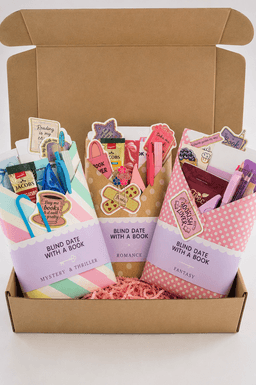
You could also try a Blind Date With a Book.
You can still choose a genre, share your preferences, and mention anything you would rather avoid. The final title simply remains a surprise until you unwrap it.
Sometimes not knowing exactly what you are getting removes the pressure to find the perfect choice. Instead of analyzing every possibility, you get to open something unexpected and see where it takes you.
Choose What Feels Right Today
Your reading mood is allowed to change.
The book you were desperate to buy last year may not interest you today. A genre you once ignored might suddenly become a new favorite. A slow-paced story may surprise you, while a book containing everything you normally enjoy may not hold your attention at all.
None of this means you are choosing books incorrectly.
Step away when reading begins to feel like an obligation. Return to a familiar genre when you need comfort. Branch out when your usual choices feel stale. Give a book two chapters, and let it go if it isn’t working.
You are not choosing the perfect book for every future version of yourself. You are only choosing the story that feels right for you now.
And if you still cannot decide, perhaps it is time to let your next book surprise you.